
How I failed publishing a Newsletter in LinkedIn
Reading Time: 4 minutesThis is not a success story, but a failure story. Because of that, I would like to say I got great learnings from my failure… but I’m not sure if I really learned something. You tell me at the end of this article.
I’ve been publishing a newsletter on LinkedIn for 3 months, and I failed to achieve my goal.
In this article, I explain what I wanted to achieve and what I did. Also, I give you my vision about why I failed, and some tips for you to take away.
🎯 The Goal
I had my goal very clear. At least I have that.
My goal was: Get more subscribers for my main newsletter The Optimist Engineer.
In my main newsletter, I write about I learn on:
I already have many people who are quite happy about the learnings I provided to them. Find them on https://optimistengineer.com/
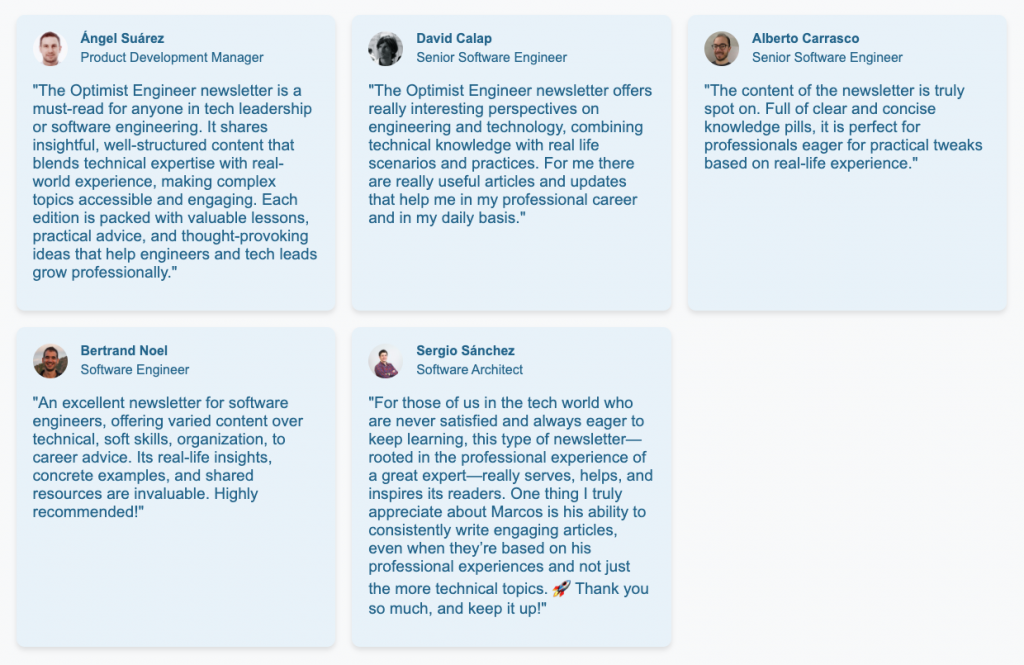
By the way, if you like to learn about those topics, so can subscribe right here 👇🏻
I planned to get attention from my network on LinkedIn and redirect them to my main newsletter.
I’ve been trying to get attention by publishing posts on LinkedIn 2 or 3 times per week, participating in comments, and so on. At that time, my network was around:
- Contacts: 1160
- Followers: 1240
With that strategy, I was not able to get people into my main newsletter. The statistics there were saying that 1 or 2 visitors from LinkedIn were coming per week.
I stopped posting on LinkedIn.
I planned another strategy, an experiment.
📋 What I did
I’ve investigated a bit and saw that LinkedIn has a feature for having a Newsletter on the platform. From what I read, that feature was kind of new and not many people were using it so far.
From there, my reasoning was the following:
If LinkedIn is pushing for this, the algorithm they have will make the newsletters more visible (or at least more than my posts).
So, let’s do it. Next question: about what?
I created a newsletter on LinkedIn where I wrote, every Tuesday, a new issue that contained a short review of 3 technical readings I selected. During the week, I read technical articles of my interest. The ones that I liked the most were included in the newsletter issue of the incoming week.
Because my job-related interests are bound with the contents I write in my main newsletter, my reasoning was telling me:
If I build a curated list of articles from other folks in the industry and a precious CTA, people interested in learning more would go to my main newsletter through the CTA.
The amount of time I dedicated to each edition was around 1 hour. ChatGPT helped me with the images to use.
But I failed. Let me give you some numbers (at the time of writing this).
From the LinkedIn statistics:
- 6 editions published.
- 6715 impressions.
- 56 interactions.
- 578 article visualizations.
- 192 subscriptions.
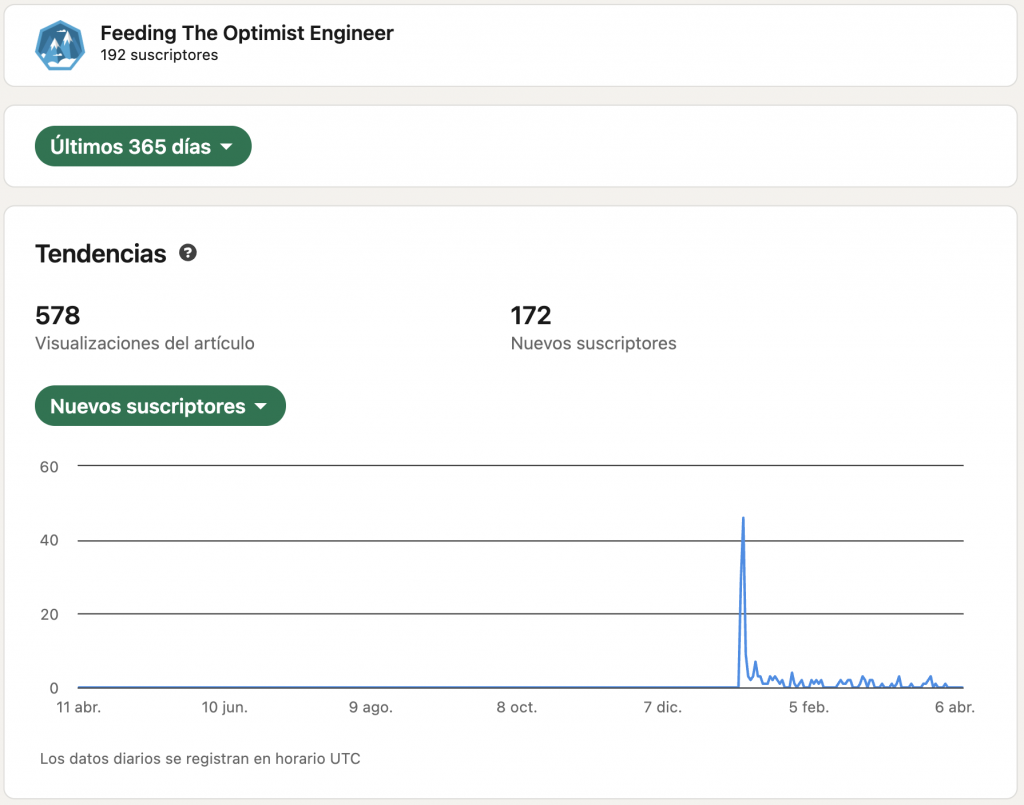
But what was the impact of my LinkedIn newsletter on my main newsletter?
The numbers below are taken since the day each issue was published on LinkedIn, plus 7 days after.
| Issue | Linkedin likes | linkedin comments | Views substack | users substack | resultant subscriptions |
|---|---|---|---|---|---|
| 2025/01/08 | 12 | 4 | 5 | 3 | 0 |
| 2025/01/14 | 11 | 2 | 17 | 11 | 2 |
| 2025/01/21 | 5 | 0 | 11 | 10 | 1 |
| 2025/01/28 | 9 | 3 | 5 | 5 | 1 |
| 2025/02/04 | 1 | 0 | 4 | 4 | 1 |
| 2025/02/12 | 9 | 0 | 9 | 9 | 0 |
You can find all the editions of my LinkedIn newsletter on LinkedIn here.
I can try to summarize that table:
- The first edition was well, it got attention, even though it did not result in any subscribers in my main newsletter.
- The second edition was promising, more or less the same impact in LinkedIn but with a bigger impact in my main newsletter: 2 subscribers!. The promise of LinkedIn looked coming true!
- From there, the attention on LinkedIn was reducing little by little, and the number of subscribers transformed was just 1 per edition.
My original goal was to attract more subscribers to my main newsletter, and for the period of 6 weeks, I got 5 subscribers. I must confess my target was wider than that.
So, I stopped the experiment, and I did a retrospective to find what I did wrong.
💣 Why did I fail
After my retrospective, I can find 3 aspects that led this experiment to a failure:
- The format of my LinkedIn newsletter may not be the right one to achieve my goal. Because my previous attempt (posting more frequently on LinkedIn) highlighted that I do not have much impact, I can think of the derivative that: I did not have enough impact on this social network to represent “a voice”, strong enough, to recommend curated information. So, people did not follow up into my funnel.
- I may not build my funnel to my main newsletter properly. I’m not a marketing person, even though I’m learning here and there, but I think I should improve the way to attract people to my main newsletter.
- I’ve never really been able to keep up with LinkedIn’s algorithm. I’ve tried several times, but I think it expects something from me that I’m just not up for.
All right, let me give you a quick summary and some tips for you.
✨ Summary
In summary:
- I invested around 6 or 7 hours of my time.
- To publish 6 issues on the LinkedIn newsletter.
- With the goal of attracting subscribers to my main newsletter The Optimist Engineer.
- And I ended up getting 5 subscribers.
Tips from my experience:
- Was it worth it? I would say yes, mainly, to discard LinkedIn as a source of new subscribers for my newsletter.
- Would I advise you to do the same experiment? Yes, given the effort that took me, it is worth trying and seeing if your path is better than mine.
- Is this newsletter feature on LinkedIn a growing feature? No, from my experience, this was a “try” from LinkedIn, and I believe is going into the trash.
- Do I have in mind to give another try to LinkedIn? No, I think the current algorithm is too demanding of my time to invest. I find it very hard to get relevance on that social network.
I would love to hear about your experiences bringing subscribers to your newsletter from other places like LinkedIn or others. Write a comment on this article or contact me via Bluesky or Mastodon.
Also, pass by my newsletter to learn from real-life lessons for thriving in Software Engineering, Technical Leadership, and Technical Growth.